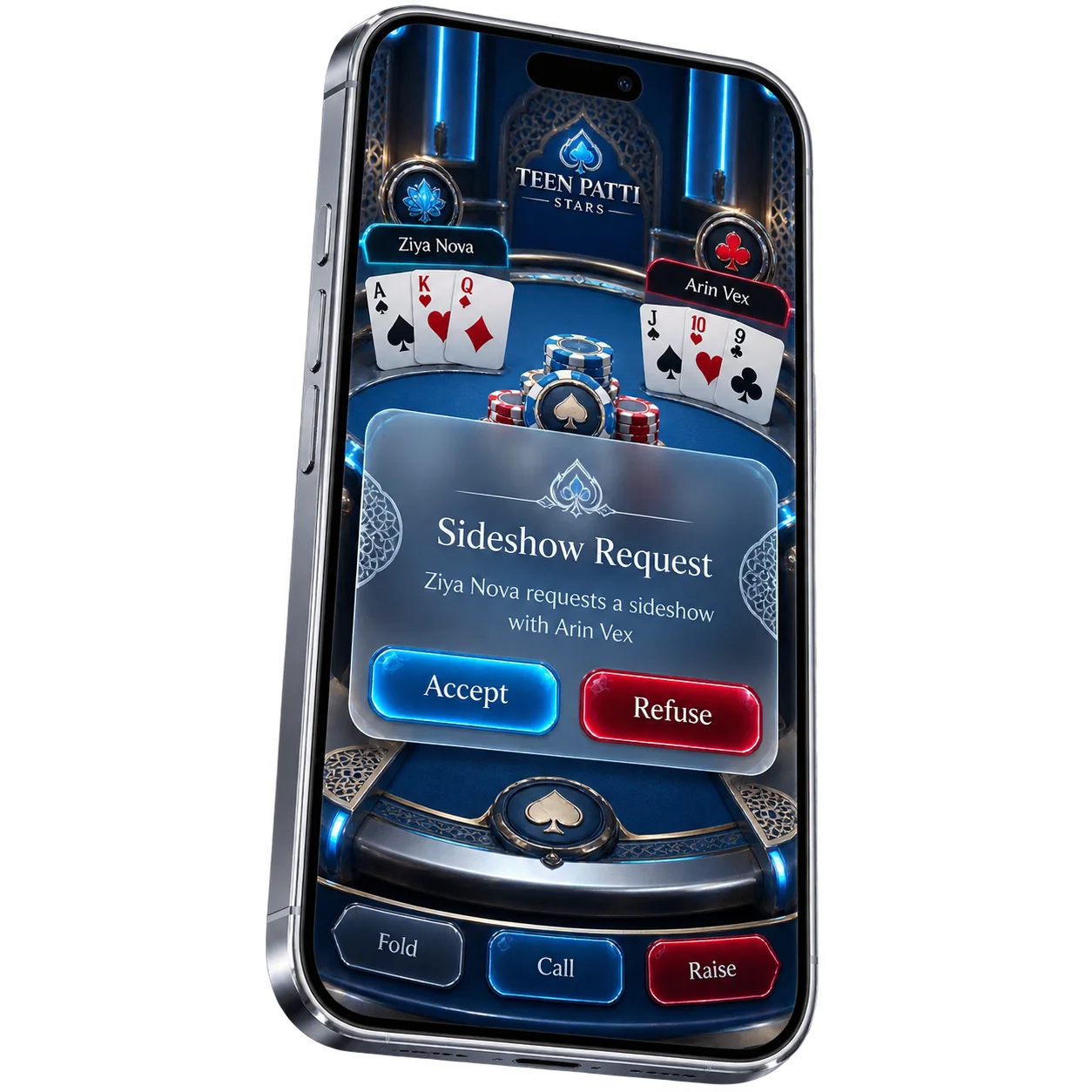
A three card betting game played across India, usually with three to six people and a standard 52 card deck. Every player gets three cards face down and nobody draws again, which means the game is decided almost entirely by betting rather than by the cards themselves. This page covers all of it, including the probability of every hand, because that changes how you bet far more than memorising a list of rankings does.
Teen Patti means "three cards" in Hindi. It is a gambling game in the same family as three card brag, played socially at festivals and for money everywhere else. Three cards each, dealt face down, no draws, no community cards. You bet, and eventually either everyone folds or two players compare hands.
The reason it survives as a game worth studying is that the strongest hand does not always win. Most hands end with everyone but one player folding, and that player never has to show what they were holding. You can take a pot with 7-4-2. That single fact is the entire basis of the game.
You will see it written as teen patti, teenpatti, 3 patti, tin patti, teen pati and teenpati. Same game. Hindi transliteration into English has never settled on one spelling, and the search results reflect that more than they reflect any real difference.
Most confusion at a Teen Patti table comes from people using these four terms loosely.
| Term | What it means |
|---|---|
| Boot | The fixed amount everyone puts in before the deal. It creates the pot and sets the opening stake. A table advertised as a 10 rupee table means a 10 rupee boot. |
| Pot | The money in the middle. Whoever wins the hand takes all of it. |
| Current stake | The amount a blind player has to match right now. It moves during the hand, and every bet is calculated from it. |
| Table limit | The ceiling on the pot or on a single bet. When the pot reaches it, the hand goes straight to a show instead of continuing. |
After the deal you decide whether to look at your cards. Play without looking and you are blind. Look, and you are seen for the rest of the hand. Nothing about the cards changes. Only the cost does.
| You are | Minimum bet | Maximum bet |
|---|---|---|
| Blind | 1x the current stake | 2x the current stake |
| Seen | 2x the current stake | 4x the current stake |
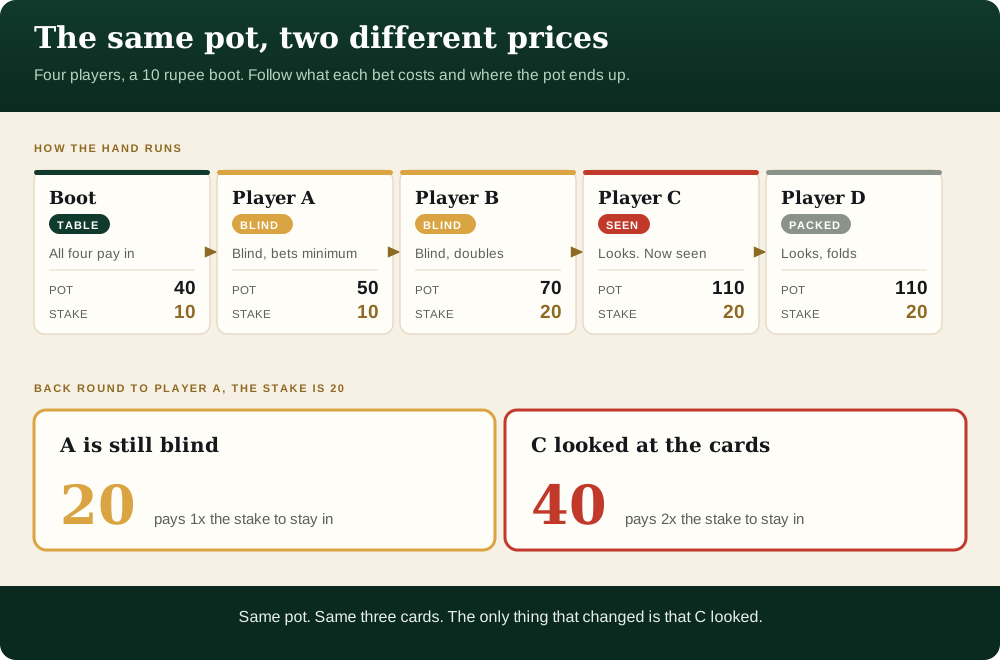
Read that table twice. It is the most useful thing on this page. A blind player is contesting the same pot at half the price of a seen player.
Four players at a 10 rupee boot. Everyone pays in, so the pot opens at 40 and the current stake is 10.
That is the trap in full. Beginners look at their cards immediately because it feels like the responsible move, then pay double for the privilege of folding two rounds later. Experienced players stay blind through the cheap rounds, let the pot build at half cost, and only look once the stake has climbed enough that the decision actually matters.
The part people miss. Staying blind also makes you unreadable. A blind player has no reaction to control, no tell to hide, and genuinely does not know whether they are bluffing. That is a structural advantage available on every single deal, and it costs nothing.
| Rank | Hand | What it is | Best example |
|---|---|---|---|
| 1 | Trail, also called trio or set | Three cards of the same rank | A-A-A |
| 2 | Pure sequence | Three consecutive cards, same suit | A-K-Q of hearts |
| 3 | Sequence | Three consecutive cards, mixed suits | A-K-Q |
| 4 | Colour | Three cards of one suit, not consecutive | A-K-J of spades |
| 5 | Pair | Two cards of the same rank | A-A-K |
| 6 | High card | None of the above | A-K-J, mixed suits |
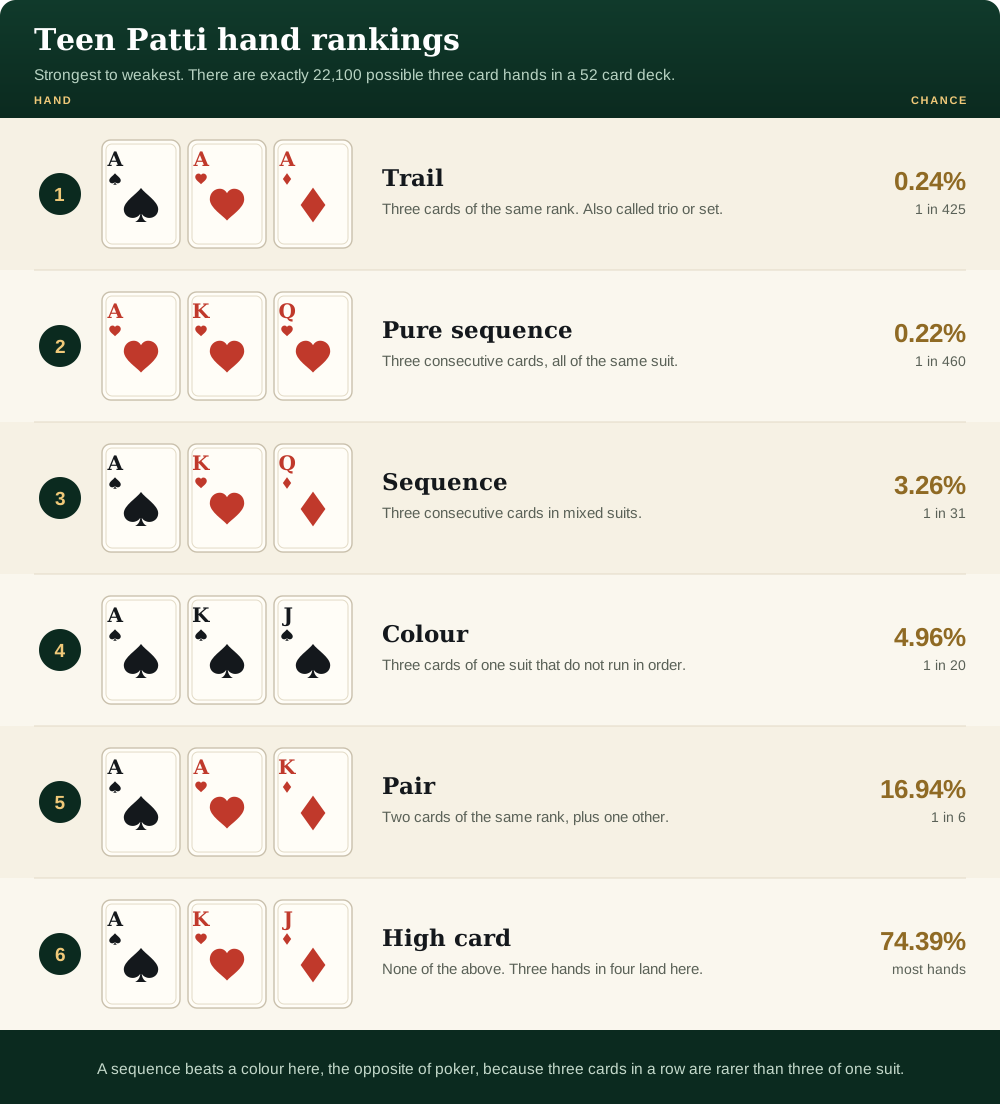
Two things in that list catch people out. A sequence beats a colour, which is the opposite of what poker players expect, and it is correct here because three consecutive cards are rarer than three of one suit. And the best possible high card is A-K-J rather than A-K-Q, because A-K-Q would already be a sequence.
The worst hand you can be dealt is 5-3-2 in mixed suits. Worth remembering, because one of the popular variants turns that into the best hand at the table.
There are exactly 22,100 possible three card hands in a 52 card deck. Every hand you will ever be dealt is one of them, and they are nowhere near evenly distributed.
| Hand | Combinations | Chance | Roughly once every |
|---|---|---|---|
| Trail | 52 | 0.24% | 425 hands |
| Pure sequence | 48 | 0.22% | 460 hands |
| Sequence | 720 | 3.26% | 31 hands |
| Colour | 1,096 | 4.96% | 20 hands |
| Pair | 3,744 | 16.94% | 6 hands |
| High card | 16,440 | 74.39% | Most of the time |
Three hands out of every four are a bare high card. Not a pair, not a sequence, nothing at all. The player betting into you almost certainly holds a high card as well, and the confidence behind their bet is a decision they made rather than a hand they were dealt.
It also resets what counts as a good hand. A pair sits in the top quarter of everything the deck can produce, so a modest pair is worth playing. A trail turns up about once in 425 deals, which at online speed is once every few sessions. Waiting for one before you commit chips means paying boots all evening and winning nothing.
Put the odds next to the betting rules and a few things follow immediately. A hand that beats a pair arrives roughly a quarter of the time. So when three players are still in after two rounds of confident betting, the chance that at least one of them holds a sequence or better stops being remote. That is the point to stop paying to find out.
It also explains why the blind pricing matters as much as it does. If most hands are a high card, most hands are decided by who was willing to keep paying. Paying half price for that argument is an edge that has nothing to do with luck.
Ranking two hands of the same type is where table disputes come from. The rules are settled. They are just rarely written down.
A sideshow, sometimes called a compromise, is a private comparison between two players in the middle of a hand. It is the sharpest tool in the game and most new players go months without touching it.
The rules are tight. Only a seen player can request one. Only against the seen player who bet immediately before them. Only after paying their own bet for that round. You cannot ask a blind player for a sideshow at all. The other player accepts or refuses, with no penalty for refusing. If they accept, the two of you compare cards privately and the weaker hand folds on the spot. If the hands are exactly equal, the player who asked is the one who folds.
What makes it valuable is not the comparison. It is the refusal. A player holding a trail almost never refuses, because they want you in the pot paying. A quick refusal usually means a bluff the player would rather not have examined. You have learned something real about one opponent for the price of one bet, in a game where information is otherwise almost impossible to come by.
Three ways, and the cost differs in each.
Once you know the classic game, any lobby is full of rewrites of it. Strategy does not carry over cleanly, so read the rule panel before you sit down.
The rankings invert. The worst hand wins, so 5-3-2 offsuit becomes the best holding and a trail of aces is worthless. Every folding instinct you built in the classic game works against you here.
Aces, kings, fours and sevens all act as jokers. Strong hands appear far more often, which means a colour that would take a classic pot loses here regularly.
One card is nominated wild, either fixed before the deal or drawn at the start of the hand. There are lowest joker and highest joker versions, and they are not the same game.
You chase a hand as close as possible to 999 rather than a ranked combination. The rankings table above does not apply at all.
Four cards each, and you build the strongest three from them. Everyone holds better hands, so bets that would be brave in the classic game are ordinary here.
Standard rankings, blind and seen betting, sideshow available. The only version where the probability table on this page applies exactly as written.
Online you lose every physical tell, which sounds like it strips the psychology out of the game. It moves it, into two things you can still observe.
Bet sizing. A player who bets the minimum for three rounds and then jumps to the maximum has usually just looked and liked what they found. Not certainty, but a pattern that repeats often enough to price in. The reverse is worth more. Someone who has been betting the maximum all evening and quietly drops to the minimum is often protecting a stack rather than a hand.
Timing, with a warning. A long pause before a big bet is sometimes genuine thought, sometimes a deliberate act, and on a mobile connection sometimes just a lost signal. Treat it as the weakest signal available and never build a whole decision on it.
The most reliable read in the online game is still the sideshow refusal. It costs one bet, and it is the only moment where an opponent has to make a decision about the strength of your hand instead of their own.
The early rounds are the cheapest you will play and being blind halves that price. Look once the stake has climbed to where the decision matters. This one habit separates a player who lasts the evening from one who does not.
Three quarters of hands are a high card. If you are seen, holding a weak high card, and someone is betting into you with conviction, folding is arithmetic rather than cowardice. The boot you already paid is gone whatever you do next, so do not pay two more bets to protect it.
Decide the whole evening's budget first, then pick a table where the boot is a small slice of it. Keeping any single hand under 5% of what you brought is a workable rule. At a 10 rupee boot with 500 rupees you can absorb a bad run and still be playing when the cards turn.
Most tables have one player raising every hand and one who only bets with something real. You do not need to profile everybody. Find the aggressive one and the cautious one, then price your bets against them specifically. A raise from the cautious player means something. The same raise from the aggressive one means nothing.
A pair is a top quarter hand and beginners fold it too often. They also overplay it. A low pair loses to every sequence, every colour and every higher pair, and together those turn up often enough to matter. Play it, but do not take 4-4-9 to the table limit.
Online hands are dealt by a random number generator and every deal is settled independently of the one before it. There is no cycle, no due card, no pattern hiding in the last twenty hands. The streak you think you can see is the same illusion people find in coin flips.
That is also the honest answer about predictor apps and hack files. If a program could read the deal, there would be no game left for the operator to run. What those downloads do is take your login. Treat anything promising to show you other players' cards as malware with a marketing page.
Where the game genuinely rewards skill is narrower and less exciting: paying half price by staying blind, folding the three quarters of deals that are a bare high card, using the sideshow for information, and deciding the budget before you sit rather than after.
Ready to sit at a table? Teen Patti Star runs classic tables and most of the variants covered here, with a practice mode you can use before any money is involved.
Three, dealt face down, and you never receive another. There is no draw and there are no community cards. Whatever you are dealt is the hand you finish with, which is why the betting decides the game rather than the cards.
Yes. Three consecutive cards are rarer than three of one suit when you only hold three cards, so sequence outranks colour. A pure sequence, meaning consecutive and same suit, beats both.
A-K-Q is the highest. A-2-3 is the second highest, which surprises most people, and after that the order runs normally from K-Q-J down to 4-3-2.
The fixed amount every player puts in before the cards are dealt. It creates the pot and sets the opening current stake. A 10 rupee table means a 10 rupee boot, and every bet in the hand is calculated from there.
No. Only a seen player can request a sideshow, only against the seen player who bet immediately before them, and only after paying their own bet for that round. A blind player cannot be asked for one either.
The player who called the show loses. Teen Patti does not split pots, so an exactly equal hand is a losing hand for whoever asked to compare.
Both, in different proportions over different timescales. Any single hand is mostly luck, since you cannot improve the three cards you were dealt. Over hundreds of hands the betting decisions dominate, and those are skill: when to stay blind, when to fold, when to call a show, and how much of your money to bring to the table at all.
"Teen" is Hindi for three. Writing it as 3 Patti swaps the word for the digit. You will also see tin patti, teen pati, teenpatti and teenpati, all of which are the same game under different transliterations.